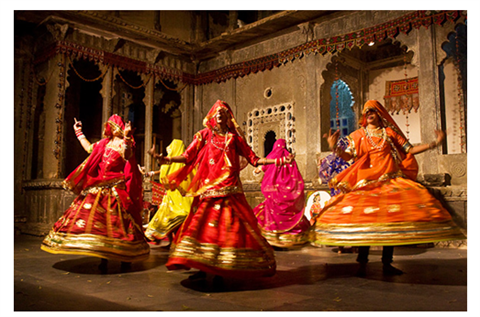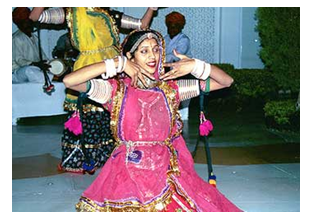
DANCE FORMS OF RAJASTHAN
Contents
- Introduction
- The Hilly Region
- The Desert Region
- Eastern Region
- Music
- The Ragas
- The Tal
- Bhajans and Banis
- Folk Musical Instruments
Introduction
Music and dance are an integral aspect of the lives of Rajsthanis. Rajasthani folk art forms are either associated with religion or festivals. The folk dances of Rajasthan can be broadly categorised into the following three categories:
- Dances of the hilly region
- Dances of the desert region
- Dances of the eastern plains, including the Shekhawati
Some communities in Rajasthan are professional performers of certain varieties of dance and the tradition has been handed over from generation to generation. Some of the major Rajasthani dances, in accordance to their broad categorisation, are briefly described as follows:
The Hilly Region
The hilly areas of Rajasthan are primarily inhabited by the Bhils and Meenas. Music and dance are a significant aspect of their lives and both men and women participate in the dance performance, without any restriction. Dances are especially performed during festivities and marriages.
Some of the major dances of this region are as follows:
- Ghoomar- It is dance performed by both men and women, and has no coordination with the musical instruments. The dance is very easy-going and no specialised movements are required during the performance.
- Ger- This dance is performed during the occasion of Holi and is performed exclusively by men. The dancers dance to the beats of big drums and Thalis or brass plates.
- Jhoria- Literally meaning a wooden stick, the Jhoria dance is performed by both men and women. The men and women stand in distinctive circles and perform a vibrant dance, to the accompaniment of Shehnai, Nagada and Dhol.
- Neja- It is a type of a dance game performed by the Meenas of Kherwara and Dungarpur. A tower is erected by the women and a coconut is tied at its top. The men try to steal the coconut from the tower, but the women try to protect it with the assistance of sticks and whips.
- Gauri- The Gauri dance is performed in the months of Sravan and Bhadon, and is dedicated to Bhairavi. It is very popular with the Bhils of Udaipur and is a complete religious dance form. During the performance, the episodes of Banjara, Bhiyanwad, Khadlia Bhoot and the tiger boar are enacted.
- Gangaur festival dance- Dancing on the occasion of Gangaur festival is very popular among the Banjaras of Rajasthan. The dancers perform to the accompaniment of Dholaks, Thalis and Katoris.
- Garva and Balar- This are the two most popular dances of the Garasias tribe.
- Shankaria- It is performed by the Kalbelias or snake-charmers and is performed in pairs. The dance involves adept and skilful physical movements, and depicts a love story.
- Indoni- It is a group dance of the Kalbelias and is performed to the accompaniment of Poongi and Khanjairs.
- Panihari- It is a couple dance of the Kalbelia tribe and its performance enthrals the audience.
The Desert Region
The major dances of the desert region of Rajasthan are as follows:
- Ghoomar- Also known as Jhumar, Ghoomar is extremely famous among the middle-class women of Jodhpur, Udaipur and Kota Bundi areas. It is a collective dance form, in which hundreds of women dancers dance together in festive mood.
- Fire Dance- It is a remarkable dance form, performed by the dancers from Dikamdesar, Bhamlu and Katriasar. Maharaja Ganga Singh of Bikaner was a patron of this awe-inspiring and sensational dance form. It is basically the dance of the Siddha Jats of Bikaner. The dancers dance through, over and on the fire. The tempo of the dance increases along with the music and in the later stages of the dance, the dancers hurl burning coals at each other, without causing any injury.
- Drum dance- It is performed by the professional dancers of Jalore and is exclusively restricted to males. The dancers perform with swords, sticks and swinging handkerchiefs, to the accompaniment of four to five drums. It is a synthesis of various forms of folk dance.
- Teratali- It is a dance form of the Deedwana and Pokhran areas of Rajasthan. The dancers are known as Kamads. The dance is usually performed by two men and two women. The men play the ektara and the women contort their bodies to create musical sounds.
- Kachhi Ghori- It is performed by the people of Marwar, during the occasion of marriage. It is usually performed by five to six dancers.
Eastern Region
The eastern region of Rajasthan is located adjoining the Braj area of Uttar Pradesh; hence there is the predominance of Nautanki, Ras Lila, Ram Lila and Nautanki in the region. The other dance forms of the region are as follows:
- Gindar- It is performed on the occasion of Holi, irrespective of caste. Nagadas and Ghungroos are the special feature of this dance. It is performed throughout the night and the dance increases its tempo in a steady manner, to the accompaniment of the Nagadas.
- Gher Ghemur- It is a simple dance form and is performed by both men and women. The men and women stand in distinct lines and form a circle. The dancers both rotate on their axis, as well as revolve around the centre. The tempo of the dance keeps increasing in a gradual manner.
- Geeder- It is the dance of the Shekhawati tribals and is performed fifteen days before Holi. The dance is accompanied with drums and sticks. Various agricultural functions and myths are also coalesced with the performance.
- Kachhi Ghori- This dance presents the horse riding, with paper and cardboard horses. It is essentially a battle, where sword and shield yielding dancers strike blows at each other. It is usually performed on the occasion of marriages and has very angular and jerky movements.
Music
Music is as important in Rajasthan as dance. The folk songs are also known as Soratha and Duha in the state. They are sung on occasions such as family celebrations, festivals, customs, rituals etc. The most popular folk songs of Rajasthan are as follows:
- Gorbund
- Hichaki
- Lawarji
- Jallo
- Kurja
- Olyun
- Sapno
- Indhani
The professional singing tribes of Rajasthan are as follows:
- Mangamars
- Kanchari
- Kalawats
- Bhawais
- Tangas
- Mirasis
- Rawals
- Qawwals
- Dholis
- Nats
- Patars
- Fedalis
- Dhadhis
The Ragas
The Ragas used in the Rajasthani folk songs are as follows:
- Bilawal
- Kafi
- Peelu
- Khamaj
- Desh
- Mand
The Tal
Tal is the rendering which unites the rhythm and ecstasy of music. The tals range from six to sixteen. The major musical instruments used for rendering the Tal are as follows:
- Chang
- Daph
- Mridangam
- Pakhawaj
- Manjira
- Nagada
- Dholak
- Dhol
Bhajans and Banis
Bhajans and Banis are the devotional folk songs. They are very popular among the Balais, Bhangis, Harijans, Chamars and Rahgars. The musical instrument accompanying the Bhajans and Banis are Dholaks, Ektaras and Manjiras. The Bhajans composed by Meera Bai, an ardent devotee of Lord Krishna, are extremely popular in Rajasthan.
Folk Musical Instruments
The different musical instruments accompanying the folk music of Rajasthan are as follows:
- Ravanhattha (a stringed instrument)
- Sarangi
- Ektara
- Kamaichi
- Chantaro or Nishan (a stringed instrument)
- Veena
- Tanduro
- Matki
- Dhibko
- Khanjari
- Bansuri
- Bankia
- Conch
- Damru
- Naubhat
- Chamri
- Dhumso
- Madal
- Mridang
- Dafra
- Dhibko
- Afang
- Pungi
- Toto
- Satara